The Statue of St. Fiacre

As promised long ago, here is another story of Adventures with Dead People.

In August of 2016, I was buying some plants for my classroom. I passed up the Calloway’s closer to the school and went to Ruibal’s. The plants could be pricey, but my mother was a certified Master Gardener, and she said they were excellent. This was back when my mother was alive and could say stuff like that directly.

I’m really straining here to slip in some details you need to know without ruining the story, but I don’t know how to do it. I’m just going to have to lay it out.

  • My grandmother Jean, my mother’s mother, had died almost a year before.
    • Not strictly relevant but entertaining in its way: my grandmother famously had a “black thumb.” Presumably, my mother’s talent with plants came from my great-grandfather, who grew “dinner-plate dahlias.” My grandmother could kill a plant just by looking at it cross-eyed.
  • St. Fiacre is the Irish patron saint of gardeners (also of sufferers of venereal disease, fistulas, and hemorrhoids, but you’ll be pleased to learn that those appear in this story not at all).
    • I knew who St. Fiacre was because my mother had long searched for a St. Fiacre garden statue. No, St. Francis would not do. And yeah, the Interwebs have All The Things, but the cost of shipping a garden statue is shocking.
  • My grandmother loved Gerber daisies. They were her favorites and everyone knew that. To this day, Dad plants them by his front door for her.

I picked up a few nice, murder-resistant, green classroom plants (sansevieria, pothos, some other leafy guys, no flowers) and then felt a pull toward a corner full of huge flowerpots. I did not need or want a huge flowerpot, so I thought, Nah, and then I thought, But then again… Oh, I wish I could explain how ordinary it is when it happens! It’s not weird. It’s not like being possessed (I assume, having been free of demons to date). It’s just a very compelling argument in my own head.

Side story: the purpose of such compulsions does not always even become clear. I was driving home from somewhere once and got close to a Barnes & Noble I liked. Now, it doesn’t take much to get me into a bookstore; it’s getting me out that presents the challenge. But this particular day, I was done with my errand and I really had to use the restroom. So I thought, no, I’ll just go home.

Barnes & Noble has a bathroom.

I know. But I could also just go home.

BUT YOU COULD ALSO GO TO BARNES & NOBLE.

We (I still don’t know who or what was the other party on the line) went around like this a few times. At one point I moved the wheel to change lanes and then said aloud, “No, okay then, I guess not,” and got back in the right lane and turned in to the parking lot, because apparently that’s what we were doing today.

I did the standard “shopping with dead people” bit: wander, keep an open mind, pick things up and put them down. Once I had used the restroom, I felt nothing compelling at all. Frustrated and feeling a little crazy, I left.

In the parking lot was the green Saturn sedan belonging to my ex-husband, Jason. Not just a similar one, but clearly his car, with the CELEBRATE DIVERSITY sticker intact. He had been in the store with me. In fact, unknown to me at the time, he was working there. But I hadn’t noticed him, and I had no idea what I should have done about it if I had.

I stood and stared at the car for a minute. Then I left. And I never figured out what the point of that whole thing could have been. Maybe it wasn’t about me at all; maybe he needed to see me for some reason. But I never spoke to him again, and after some years he died quite suddenly.

And yes, in fact, I did hear from him after he died, which was especially interesting because he was an atheist. His grandmother, a sweet-tempered and deeply devout Christian, is one of the few people who’s ever visited me in a dream, and I assume it’s because Jason himself simply did not truck with that nonsense. I remember only that the dream had snow in it, and that at the end, I didn’t want her to leave, so she started to…materialize, I guess. And at that moment I learned I did not ever want to see a real ghost. Ever. And thankfully, I haven’t yet, and I hope I never do because I’d be terrified.

Jason never would have been so overt—even in life he was so unassuming—so he sent me one of those “coincidences” that will never convince the unconverted but work quite nicely for me. The morning after I learned of his death, I heard a song by Throwing Muses, a band he had loved that I’ve hardly ever heard on the radio. I said aloud, “You have my attention.” The next one was Tori Amos’s “Cornflake Girl,” another deep cut from an artist he liked. “Okay,” I said. “If the next song is by Natalie Merchant, I’ll know it’s you.” And damnit, it wasn’t Natalie Merchant…exactly. It was 10,000 Maniacs, which is the band she was in before she went solo. Close enough, says I. I was moved, and a little awed, and grateful.

But why couldn’t he have just opted for one of her solo hits? There were plenty. And why “Cherry Tree”? It’s about illiteracy, of all things. And of all the Tori Amos songs he’d put on my mix tapes, “Cornflake Girl” had never appeared. It always goes like this. Some part of the experience is always not quite cooked to order.

I am quick to acknowledge that such a discrepancy between the request and the result could occur because it’s all coincidence and none of it means anything! That’s a very respectable and defensible point. You’ll never embarrass yourself in polite society with a stance like that. You’ll always win that argument. But this story is maybe not for you.

By that August, I had had a few of these experiences, enough to recognize the wordless pull of Psst! Over here! I did not need a huge flower pot. But I rolled my cart into the corner anyhow…and a door opened. I had never noticed a door in that corner of the greenhouse. I went through it, and to my left were large concrete garden statues. I knew Fiacre would be there. I recognized him immediately by his spade, but I checked the tag to be sure. Two hundred bucks was steep, but I knew my family had to have him. I lugged him up into the seat of the cart.

In those days, Ruibal’s had a little food market, and I had been planning to pick up a few groceries. But before I could get there, I was beset by courteous employees who wanted to help me get my cart to the checkout. I saw their point. St. Fiacre was heavy and two feet tall and cumbersome and leaning dangerously out of his seat. I let them take the cart and trotted behind. As we swept through the market, I grabbed a loaf of bread from a display and chucked it onto the checkout belt: at least I could check that off the list.

And St. Fiacre was on sale! Score! After I got in the car, I looked at the receipt to see how much I had saved on my discounted saint. The first three items on the receipt were “St. Fiacre” and “Grandma’s Perfect White Bread” and “Gerber Daisy.”

I had not bought any Gerber daisies.

Fear not: I’m pretty sure the imaginary Gerbers weren’t more expensive than what I actually got. In my experience, the Dead Relatives are pretty budget-conscious. As you will see.

I was dying to talk this over with my mother, but my parents were out. Finally, I left St. Fiacre by the back fence where they’d see him right away when they got home. Mom said later that even though she wasn’t wearing her glasses (and her eyesight was terrible), as soon as they turned into the alley, she said, “Oh, that must be St. Fiacre,” as if she had been expecting him any day. When I spoke with her that night, she offered to pay me back. I said not to worry about it.

A few weeks later, I was visiting my parents, and Mom approached me with some cash in her hand and the oddest look on her face: a little hesitant, a little dazed. She explained haltingly that actually, it was my grandmother who had been looking for the St. Fiacre to begin with. She’d wanted it as a gift for my dad, who had taken up gardening in the last few years. She’d told my mother to buy it if she ever found one, and my grandmother would pay her back.

“But you don’t have to pay me back, it’s fine,” I assured her.

“Well…I’m not. She is. I’ve been keeping blankets in the bureau I got from her house. I’ve been using those drawers for a year and never saw anything. But today the corner of the drawer liner was folded up, and this was under it. So I think this is yours.” She handed me two hundred-dollar bills: the original price of the St. Fiacre.

I keep wanting to explain that I am not insane or stupid. I know how probability works, more or less. I live with garden-variety coincidence every day of my life and don’t get hung up on it. I can’t prove anything or convince anyone, and I promise I’ll never try because that would be crazy. It’s not the things that happen. It’s the way they feel when they do.

I’ve been sad lately, and agitation seems to cause static in my reception. So it’s been quiet in my little World of Woo-woo. But last week I went out for a walk for the first time in a while. I wondered what it might be like to feel my mother’s spirit so surely that she could tell me where to turn. Not that it mattered where I walked, but just to feel her, to be less lonely. And I got the urge to cross the street at a random point. I didn’t credit the idea with any particular importance. Then again, what would it hurt to just go with it? Why not? It was late at night. No cars, little light. As I crossed, I said in my head, I hope you know that normal people call this mental illness. Now I was on the other side of the street. Looked pretty much the same. But now I was close enough to see a mailbox that stood in shadow; I almost walked past it before I turned around. It was decorated with astonishingly realistic butterflies: one of my mother’s many sigils (probably the most conventional one in a long list that includes carousel horses and Jackson’s chameleons). It was beautiful. It didn’t change my fate or anything. But I got to see it because I crossed the street. That’s all. It’s like that.
In Which My Dead Relatives Do Not Buy Me Margarita Glasses

For the first few weeks after she died, I could easily feel my mother around me all the time. I actually got a little worried about what it meant for my life that my mother would be living in my head for the duration. It was better than being sad, but it was taking some mental adjustment.

It is perfectly childish to be in deep mourning for a man who is actually staying…with you in your house as a guest. I call it grotesque.

Oscar Wilde, The Importance of Being Earnest

But it’s beginning to dawn on me: I’m not still alive only to be my newly ascended mother’s priestess. And I may not be able to feel her so easily forever. What’s the point of dying if she’s just going to be the same as she was before? Most likely, even the dead can grow. Especially the dead. Depending on where they’re planted.

Sometimes in those first weeks, I could feel her elation: Finally! Let’s get outa here already! Let’s get on with it! Surely she hadn’t been herself, the self she was in her own mind, for a very long time. And maybe she wasn’t herself—her truest, best self—most of the time I knew her, because maybe having kids wasn’t part of that self-concept. All this to say: the more she comes into her own, the less familiar she’ll feel to me.

So I like to remind myself about our favorite pastime, Shopping with Dead People. Our family motto: You will never shop alone.

Only a few years after Mom started chatting with the Dead Relatives, I got engaged to Dave. The wedding would be held in my parents’ house, catered by the parents themselves, officiated by a more-or-less nondenominational minister Dave’s parents knew, and attended by some high-school minions from the Key Club. So it was a pretty modest homegrown affair. After gasping at the cost of capital-W Wedding Gowns and Wedding Cakes, we went with neither, opting for an ivory damask two-piece skirt suit and a pretty floral cake in three separated tiers.

It was a fun* way to plan a wedding, but it did mean that if we didn’t think of it ourselves, it wasn’t going to get thunk. For instance, we came this close to having no music because we hadn’t sorted out who was going to press Play, and I couldn’t very well do it from the top of the stairs, now, could I, Dave (as I hissed at him over the banister, seconds before my big entrance)?

*Sometimes.

According to Mom, the Dead Relatives often came on shopping trips while we were choosing decorations and what-have-you, and that was nice. I had only Mom’s word for it, but I was happy if she was happy, and I had no pressing metaphysical or practical reason to doubt her, and together we all bought many shiny things.

A week or so before the wedding, Mom and I were rolling through the JCPenney housewares department when she stopped suddenly in Bedding and put her hand to the side of her head.

“Either I need to eat something,” she announced, “or someone is talking to me.”

“I don’t know what’s in the food court, but—“

“No, it’s over there. We need to be over there.”

Well, sure. I had no other plans. Why not? We pulled the cart around a corner, up to a large display facing the entrance from the mall. Still frowning and looking down in concentration, my mom pointed toward the display and said firmly, “There. We need something over there.”

Beloveds, I admit it: I faltered. My faith wavered. And I thought desperately, I have been a complete fool. Dead is dead, life has no meaning, and my mother is actually, literally, certifiably insane.

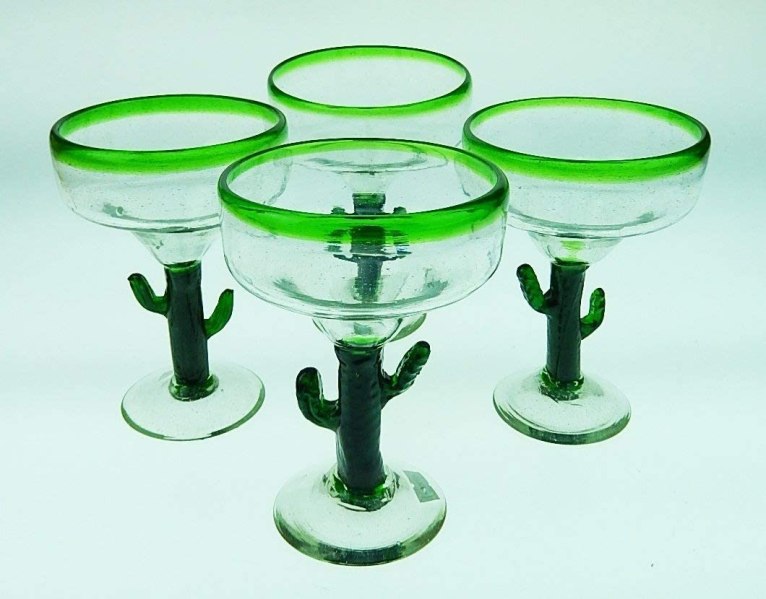
The display was a seven-foot-high wall of boxed margarita glasses shaped like saguaro cactus.

I am sure of so little in this big world. I am naive, suggestible, and dangerously open-minded, and I have believed (and do believe) in notions that make sensible folk shake their heads: fairies, shamans, St. Anthony’s interest in my lost car keys. But I knew absolutely at that moment that we did not, had not, would not ever, need a margarita glass shaped like a saguaro cactus.

How, how to explain this to Mom? How to reassure her that I still loved her even if she had been playing me all this time in some sad bid for attention? And get her to leave without buying one of these monstrosities? And convince her that I would definitely visit her in the institution if she would just quietly go with the nice men and put on the pretty jacket with the shiny buckles?

I cleared my throat. “Um,” I said. “Uh, Mom? Um, I don’t…think…”

She waved her hand impatiently. “No, no,” she said. “Not those. Behind there. Get in and look.”

The wall of boxes was hiding and mostly blocking a baker’s rack scattered with clearance merchandise. I wedged into the space and held the sad little items up for inspection: an open bag of pillowcases? a chipped butter dish? a drawer pull shaped like a wrench? What was I looking for?

“I don’t know yet. Keep going,” she instructed. “What’s in the back?”

I groped blindly with one hand and came out with a gray box marked “$4.00.”

“What about that?” my mother said. “Open it. Be careful.”

“I don’t even know what it is.” But, according to the logo on the other side, it was Waterford (a symbolic favorite of my Irish-American family, though it’s largely made in Eastern Europe now). I couldn’t guess what useless castoff of Waterford Marquis could be marked down to four bucks, but I imagined it was in several jagged pieces.

But it wasn’t. I pulled it out and put the box on the shelf, cradling the smooth figure in both hands. It was a clear, bright figurine of a man and woman of equal height, standing together, side by side. The woman wore a veil and carried a bouquet; the man held a top hat behind his back.

Mom and I stared at each other. Finally, she asked, “Do we have a cake topper?”

“I thought you were getting the cake.”

“We are. But you know it’s not a wedding cake.”

“I didn’t think about a cake topper.”

She exhaled heavily and smiled. “But someone did.”

When we told this story later, Mom would cackle maniacally and say, “You should have seen the look on your face!” when she’d pointed at the margarita glasses. I can only imagine. She herself was beyond surprise.

Something Wonderful Can Come

There is no doubt that Marley was dead. This must be distinctly understood, or nothing wonderful can come of the story I am going to relate.

Charles Dickens, A Christmas Carol

My mother died suddenly last weekend. My father found her at about six o’clock Saturday morning. She suffered from COPD for years and wore a nasal cannula at all times, but she had been going through a less-bad patch lately, and she wasn’t even seventy years old. She seems to have died in her sleep. Dad called the paramedics and my sister; I didn’t wake up when he called me. My sister called a funeral home. The police came.

By the time I awoke, Mom was laid in the front hall with a sheet over her, on a rug Melissa now never wants to see again, my father kneeling beside the body, clutching Mom’s St. Jude’s medal and the little angel charm her mother had given her. Since she wore them all day, every day, on the same chain, a pointy bit of the angel had made a little dimple on the back of the St. Jude medal. Mom used to joke that the angel had kicked St. Jude in the butt. I slept through all the action Saturday morning, for which I’m deeply grateful. I’m sorry that poor Melissa had to manage it all, but I do not wish to have been there. I won’t lie.

I answered the phone around nine o’clock, and the numbness carried me along for hours. I brought over some cookies. I apologized to Melissa. I petted my parents’ cat. I watched a show about black holes, which apparently “feed, burp, and nap” like babies. I texted some people. No, there wouldn’t be a funeral or a viewing. No wake. The body would be cremated in the “peached cotton” Eileen West pajamas I had gotten Mom last year.

Stay with me, here. This is not a story about being sad.

I don’t know how to summarize the necessary context succinctly. I’ll tell those stories later if you’d like. For now, just know that Mom and I already suspected that dead may not be as dead as all that.

To put it bluntly: for about twenty years, my mother had been getting sporadic messages from dead people. Not telegrams, not voices or visions. But promptings. Sometimes quite specific promptings that required that she and my long-suffering father drive to Bonham, for instance, or buy beat-up old silver butter dishes or carved cookie molds. I got wedding presents from my dead relatives, which was sweet. Mom said they had an eye for quality.

As you might imagine, my mother was, how shall we say…fanciful. Prone to embellishment, perhaps, with the Irish instinct for the good story (as superior to the objectively factual one). She saw signs of her affectionate long-dead relatives everywhere —and she did genealogy, so she knew lots of dead relatives. My dad said she was nuts, even as he indulged her. I’m not going to argue for her sanity. She was who she was.

The crucial thing is, though, that I am considered (more or less) compos mentis, and I was there—when she found the old dime store she had already described from her dream, for instance, or when, feeling “someone talking” to her, she and I stuck a hand into a housewares clearance rack and came out with the Waterford cake topper that I needed for my wedding cake but had completely forgotten about.

As time went on, I occasionally experienced those promptings myself and felt my way into a few of those weird adventures on my own, though she almost always was able to clarify or illuminate events afterward. So it’s not like I’m taking only her word for the reality of this feeling. I’d been there before. Just not so alone.

Naturally, with that history behind us, I was primed right away to receive any greetings she might send. At the same time, my mother was dead, and that was devastating, and I grieved, but less than I expected. Sometimes when I wasn’t crying, I was oddly euphoric. And I felt like she was, too.

Until Friday, all her greetings were clear enough to me but easily explained away by coincidence, had anyone been so inclined. For instance, on Saturday night, she sent me a beautiful snail shell and some lightning bugs; the next day she arranged for me to see a YouTube video in which spirits manifested as lightning bugs on a screen.

That’s the way it works, you see: snails and lightning bugs aren’t unusual. It’s about the context, the surprise, the way I think, “Mommy, where are you?” and immediately the little honeybee comes from nowhere and lands on me. I don’t see or hear ghosts (though my grandmother did), because that would scare me. Just this, just little things, all week. The candle that burned from Saturday morning until the hour she was cremated. My son’s sudden discovery of “100 Years,” which she loved and which made me cry.

Until, on Friday, Mom decided to pull out all the stops.

On Friday, I dropped my devoted friend Holly off at the airport, which left me truly alone in my head for the first time since Saturday. The traffic was unusually heavy because of the holiday, and Waze seemed to make itself crazy trying to route around it. Finally, it sent me so close to Henk’s German bakery that it seemed silly not to go, having gone so far out of my way already.

German food was important in my Irish mama’s life (because reasons), so she liked this place. Yes, I explicitly hoped she had left something for me. I knew how Mom shopped with dead people: keep an open mind. Reduce expectations. Pick stuff up and put it down. Pay special attention to shelves at knee level. So I went in and wandered through the little store. The last time my mother and I were here, she was in a wheelchair, sitting with her oxygen tank, and couldn’t really get down the aisles. I did not like to think about that.

Bunratty’s Mead, in a German bakery? Odd. But no. Licorice? Yes, my grandmother loved licorice, but…no. Candy fruit slices? Well, maybe. My sister loves those, and Melissa is a strict atheist, so I’m Mom’s only vector to send her a present. What the heck is this music, mariachi? Strange choice, Henk, very strange.

I was getting discouraged. What would Mom do? She used to tell me I was too prone to literalism in this arena. For instance, when the dead relatives sent me a cookie mold, I thought I had to make them cookies. She said I was missing the point, which was that I HAD GOTTEN A PRESENT FROM DEAD PEOPLE. So maybe I was being too narrow in the search. Just because I was in a store, did that mean I was there to buy something? Maybe I was there to meet someone, for instance? I side-eyed the elderly gentleman checking out the stroopwaffeln, and then I heard the song on the music system. This was no mariachi band now. This was the Kinks.

I had never heard it before, or if I had, I didn’t remember it at all. It was not familiar. But it was obviously the gift I was there to get.

Thank you for the days
Those endless days, those sacred days you gave me
I’m thinking of the days
I won’t forget a single day, believe me

I bless the light
I bless the light that lights on you, believe me
And though you’re gone
You’re with me every single day, believe me

Days I’ll remember all my life
Days when you can’t see wrong from right

You took my life
But then I knew that very soon you’d leave me
But it’s all right
Now I’m not frightened of this world, believe me…

“Days,” Ray Davies

I was too stunned and breathless even to cry. I made sure I remembered a few lines verbatim—You’re with me every single day, believe me—oh God, Mom, I hear you, oh my God—walked out, sat on a bench, and looked up the song. When I felt a little steadier, I drove home.

Now. This is a good story. I longed for a definite message from my mother, and I think I got one. This is a beautiful and touching story. But it is not over, because my mother is in a very good mood this week, and she loves me, and she may be showing off a bit. She’s entitled to it.

When I got home, I dutifully sent my father an e-mail describing what happened, even though I knew he’d think I was dotted-swiss crazy. Be it not upon my head if Dad still believes Mom is actually gone. I wasn’t out to change anyone’s mind, and I’m not now, either.

Friday evening, I looked up the song again, wanting to savor and study every word. On the bottom of the lyrics page was the release date of the song: March 25, 1972.

March 25 is my parents’ anniversary. March 25, 1972 is the day they married. This March would have been their fiftieth anniversary.

Hey, I believe in science. Don’t ask me how any of this works. But also don’t try to tell me my mother is gone from me. How could I believe that, when this is my life? This happened. She’s with me every single day, believe me.

Ramana Maharshi…was surrounded by weeping devotees as he lay dying, pleading, “Don’t go, Master, please don’t go.” To which Ramana responded, “Don’t be silly; where could I go?”

Ram Dass (paraphase by Eliezer Sobel)