Following up on the “Days” phenomenon reminded me of another occasion where my dead mother somehow pulled some strings and convinced an innocent stranger to aid her in her hocus-pocus. Last time, I had an anonymous poster of song data to thank; this time it was, I suppose, a Fitz & Floyd warehouse worker hassled by rush holiday orders.
You have to understand my mother’s relationship with Christmas artifacts.
When my Catholic mother first proposed to wed my Jewish father in the early 1970s, her local Catholic Church authorities were less than supportive. She did not get a church wedding, and she seldom entered a church after that, though she did enroll me and Melissa in CCD classes. Dad took us. After we moved to Texas in 1988, our new Catholic church was kind of stoked about having its very own Jew. I don’t know if they had ever seen one before.
My theory is that, disenchanted with the traditional Christian godhead, she spent the rest of her life worshipping a personal God cobbled together from her favorite mythical or near-mythical male figures: her great-great grandfather Patrick Balfe, her grandfather, and Santa Claus.
The conflation of those last two is understandable. When her father broke the news about Santa Claus to my mother’s older sister, my mom found out, too. At five years old, she was not ready, and her heart was broken.
That same year, her grandfather died. She would wait on the back steps for him to come get her every Thursday, and they would go for ice cream, just the two of them. But while she was waiting one evening, the news of her grandfather’s death came to the house. No one thought to go and find Patti, waiting on the steps. She waited for hours. Her grandpa always came for her on Thursdays.
Patrick Balfe is the family patriarch, who sailed from Ireland to New York and opened a bakery in the Five Points before moving the family business to Brooklyn. Once my mom’s genealogy obsession unearthed his documents and his photo, she embraced him enthusiastically. His portrait hangs over my parents’ mantel, complete with shillelagh just barely visible in the corner.

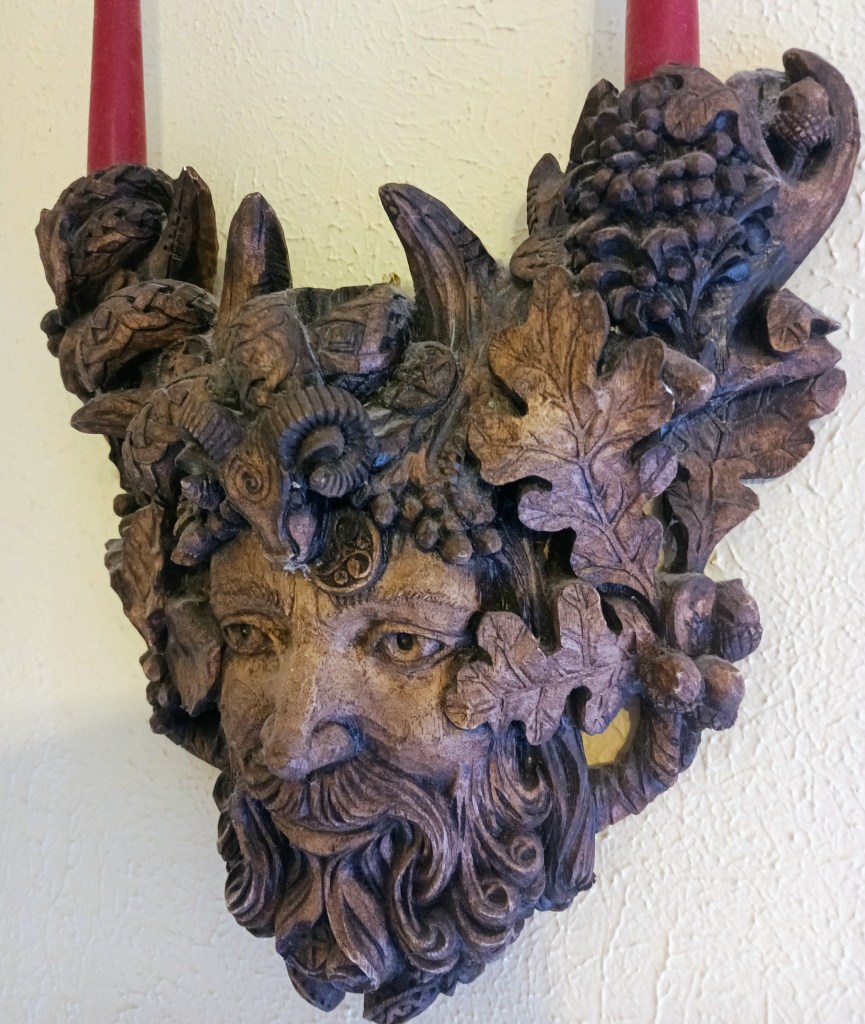
The fourth personification of the male principle she was worshipping, now that I think about it, was the Green Man. She was wary of anything that looked like ritualized magic, which raised her Catholic hackles—she didn’t even like my playing Dungeons & Dragons (as an adult!)—but she adored all manifestations of the Green Man. We saw him everywhere, and we considered him a personal friend.
Because we so loved the Green Man, I bought a beautiful carved wall sconce of the associated god Cernunnos from Paul Borda at an Irish festival many years ago. As he wrapped it, he told me the story of the Oak King and the Holly King, and he handed me the heavy package and looked me in the eyes and said seriously, “He’ll take good care of you.”
Later I also bought the female counterpart of the piece, but it was mostly out of guilt—I had been reading up on Wicca and feared I was unwisely neglecting the female principle. Both heads hang in my bedroom now, but I never felt the same attraction to her. She’s beautiful, but he’s the one I can see from my bed. I’ve inherited my mother’s (unfair and probably not even healthy) reflexive affinity with the masculine.
Mom’s worship of Santa Claus eventually took the form of obsessive cross-stitch. She was fiercely ambitious and exacting. That made her a difficult mother, but it resulted in twenty or so of the most beautiful and complex cross-stitch works I’ve ever seen, growing steadily more dazzling even as her arthritis progressed. And the idea of Santa Claus as a kind of patron saint grew and became almost separate from Christmas (naturally—what’s the use of a God who comes out only once a year?).
For one thing, the complexity of her cross-stitch projects required her to start them in March if she cared to have them finished by December, so their production was on a constant rolling schedule independent of the seasons. And their display stopped being seasonal, too, especially as she got interested in less and less standard-looking Santas. She liked Santas in blue or green, or in fur coats. They didn’t have to be fat, or jolly, or even smiling, but they did have to have kindly faces. That was very important.

So the symbols of Christmas were the important thing, and honestly, they were what we truly worshipped every year. Mom wanted nothing to do with Jesus or religion, but she wanted the beautiful things that Christmas occasioned. Her highest compliment for a thing was that it was “special”: handmade, or hard to come by, or rightfully expensive. She loved the things that shine.
When I was in my twenties, we visited a Fitz & Floyd outlet store near my house to see what was special there. Oh, did my mother love that Fitz & Floyd ceramic glaze! It was very special: both expensive and shiny. When we found an entire Fitz & Floyd nativity in the outlet store, she couldn’t believe our luck. She had already given me my great-grandmother’s little carved nativity, so I didn’t feel I needed another one, but that old thing looked like nothing next to these figures: large, elaborately decorated, colorful, gilded, glowing with that signature pearly sheen.
She couldn’t stand to see me pass it up, so she and Dad bought it for me on the spot: Joseph, Mary, Jesus-manger-lamb (all one piece), three Wise Persons, donkey, cow, creche. All the basics covered. She tried in later years to convince me to buy the remaining pieces, but they were so expensive. What would I even do with all those camels on their spindly breakable legs?
Of course I was thinking of my mother that first year after she died, pulling my exquisite creche out in late November with all its cheerful red boxes of figures nestled in Styrofoam. And I thought perhaps I’d get myself a little present from the Fitz & Floyd Web site (the outlet store had closed long ago): I could spring for one camel, the one lying down so I wouldn’t worry so much about breaking the legs off. And there was a cute salt-and-pepper set that looked like chickens. It was on clearance for five bucks; I bought that too.
Partly, I settled on the camel because Mom had specifically urged me to buy one a few years before. Really special things aren’t available forever. So was it really my idea to place this order? I certainly thought it was. I will admit every time that I don’t know the first thing about how it all happens. I only know it happens.
When the box arrived, it seemed overly large for two smallish items. When I opened it, I found the box for the camel; the box for the little chickens; and a third, large box, about fifteen inches square, that was utterly unrelated to anything I had ever purchased, looked at, or thought about.

This box was not on the shipping list or the receipt. It had somehow slipped in unnoticed, even though it was easily five times the size of anything I had actually purchased.
It wasn’t only that it was such an unlikely surprise. It was so obviously from my mother—even my sister, who thought Dad and I were delusional, had to admit it was exactly Mom’s taste. It was so clearly what she would have bought me. It was gilded, shiny, elaborate, eye-catching, and unmistakably special.
You could reasonably say, in fact, that it’s a bit much. But it’s not like I put it out every day. For everyday use, I have my mother’s spirit and her carved and cross-stitched gods, their kindly faces in every room.
I find letters from God drop’t in the street, and every one is sign’d by God’s name,
Walt Whitman, “Leaves of Grass”
And I leave them where they are, for I know that wheresoe’er I go,
Others will punctually come for ever and ever.

